
How to Specify Shore A Hardness and Materials for Rubber Extrusion Seals (LG-RX)
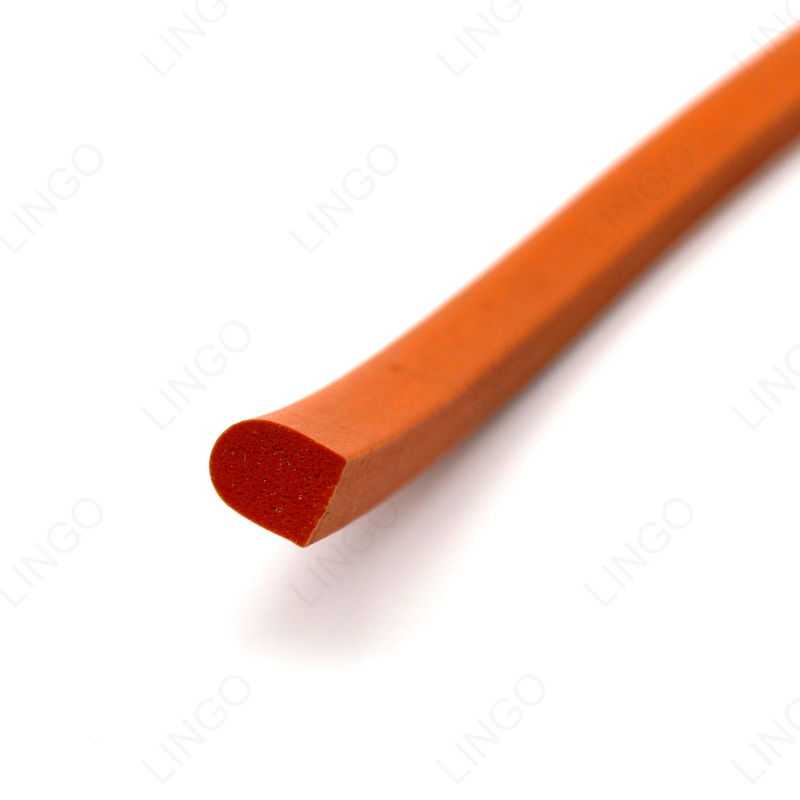
Cover: silicone sponge rubber extrusion cord — a continuous sealing profile produced on the rubber extrusion platform.
Two extrusion seals can share the same cross-section drawing, the same supplier and the same price, and still behave completely differently in service — because one was specified at 60 Shore A in EPDM and the other at 80 Shore A in NBR. In green energy equipment, that difference usually surfaces as a battery enclosure gasket that stops recovering, a weatherstrip that cracks after two summers outdoors, or a seal that turns rigid on a winter start-up. Behind each of those outcomes sit two specification decisions: Shore A hardness and polymer family.
This guide is written for engineers, procurement teams and OEM project owners who need to lock a specification rather than learn what a rubber seal is. It covers the four polymers extruded on the LG-RX platform — EPDM, NBR, silicone and FKM — how each behaves outdoors and in contact with oils, how to translate a sealing requirement into a Shore A number, and which customization parameters such as length and colour to Pantone or RAL can be fixed on the order.
Quick answer
- Polymer first, hardness second. The polymer decides media, UV and temperature resistance; Shore A decides conformability, compression set and gap-extrusion resistance.
- LG-RX rubber extrusion seals are produced in EPDM, NBR, silicone and FKM, with hardness to Shore A as required, length as required, and colour customized to Pantone or RAL.
- Green energy assemblies usually combine years of UV and ozone exposure with thermal cycling, so weathering resistance and heat stability generally carry more weight than oil resistance.
The Specification Problem Behind Most Extrusion Seal Failures
An extrusion seal is a compression element. Its function is to stay compressed between two surfaces so the elastomer keeps pushing back and blocks the path of water, dust, air or noise. Almost every field failure of a rubber seal can be traced to one of five mechanisms, and each mechanism maps to a specific line in the specification.
- Compression set. The profile takes a permanent deformation and stops exerting sealing force. It is controlled by polymer choice, hardness and the compression percentage designed into the groove, and it cannot be corrected later by tightening a dimensional tolerance.
- Ozone and UV cracking. Fine surface cracks appear on the exposed face after months outdoors. This typically happens where a compound was selected for oil resistance while the seal actually lives in sunlight and ozone.
- Media swelling or hardening. The seal grows in contact with oil, fuel or cleaning agents, or hardens after repeated wash-down. This is a polymer compatibility question, not a hardness question.
- Low-temperature stiffening. A profile that feels flexible at room temperature can become rigid in cold start-up conditions and leak at the moment the joint is under the most stress.
- Gap extrusion. A soft compound is pushed into the gap between two flanges under pressure and is permanently damaged. Raising hardness or adjusting the cross-section geometry is the usual remedy.
Most of these arrive at a supplier described as a quality problem, but the root cause is usually that hardness and material were copied from a previous project instead of being specified for this one. Defining the operating environment first is what makes the rest of the specification sequence stable.
Industry Background: Why Extrusion Seal Specifications Are Getting Tighter
Market context explains part of the pressure. Grand View Research estimated the global gaskets and seals market at USD 63.09 billion in 2024, with the seals segment holding a 60.1% revenue share. Cognitive Market Research put the global rubber molding market at USD 54.1 billion in 2024, with injection molding as the leading process type and EPDM as the dominant material.
Scope matters when those figures are compared. A narrower estimate that counts rubber seals only comes in at roughly USD 42 billion, so published market sizes should be read together with the material scope they cover rather than ranked directly against each other.
On the supply side, China's rubber parts industry accounted for more than 35% of global production in 2024, driven substantially by EV battery sealing and thermal management demand. That shift changed a great many specification conversations. Battery enclosures, inverter cabinets, heat pump housings and outdoor tracker hardware all hold a seal in place for years while subjecting it to thermal cycling, rain and UV — conditions that a compound chosen purely for oil resistance will not survive.
Standards give buyers a shared language for those requirements. EPDM materials are formally classified under ASTM D1418 and ISO 1629, the standards that define their resistance to ozone and UV, and rubber materials for automotive seals and gaskets frequently need to comply with ASTM D2000 for temperature and oil resistance. When a material datasheet arrives without a classification reference, those two documents are usually the first thing an OEM engineer requests.
Lingo Rubber Plastic (Hangzhou Lingo Rubber and Plastic Product Co., Ltd) is one of the manufacturers working in this segment. The company was founded in 2022, operates a 3,000 m² facility with around 40 employees including a 10-person R&D team, and exports about 80% of its output to the EU and USA. Its production covers rubber molding parts, rubber extruded parts, plastic injection parts and plastic extruded parts, and the extrusion seal range discussed in this guide is the LG-RX platform.
Material Selection on the LG-RX Platform: EPDM, NBR, Silicone and FKM
Rubber extrusion seals (LG-RX) are continuous profiles: a compounded rubber is pushed through a die and vulcanized, producing an endless seal that is then cut to length. The platform covers silicone rubber extrusion seals, adhesive-backed extrusion seals, co-extrusion seals, FKM extrusion seals, solid extrusion seals and sponge extrusion seals.
Before polymer choice, two structural decisions set the behaviour of the profile:
- Solid or sponge. Solid profiles carry more sealing force per unit of compression and suit joints where a defined load is acceptable. Sponge profiles seal at very low closing force and are used on frames, doors and panels that cannot tolerate much load.
- Single or co-extrusion. Co-extrusion combines a harder base with a soft sealing lip, or a sponge core with a solid skin, inside one continuous profile. An adhesive backing adds a self-grip option for installation onto panels and frames.
Polymer choice then constrains everything else. The table below compares the four families used on LG-RX. The characteristics reflect widely recognised material classifications — EPDM, for example, is classified under ASTM D1418 and ISO 1629 for ozone and UV resistance — and should be read as directional guidance for shortlisting. Confirmed limits for a specific application are established at sampling, not inferred from a general table.
| Polymer | Outdoor weathering (UV / ozone) | Oil, fuel and grease | Heat and low-temperature behaviour | Typical extrusion seal role |
|---|---|---|---|---|
| EPDM | Strong — the family classification itself is defined by ozone and UV resistance. | Limited — generally not selected for continuous oil contact. | Stable through outdoor thermal cycling; suited to moderate heat with constant sunlight. | Door and window seal profiles, panel and cabinet gaskets, outdoor enclosure weatherstripping. |
| NBR | Moderate — needs protection where exposure is permanent and outdoor. | Strong — the standard choice where oil, fuel or grease contact is continuous. | Suited to moderate service temperatures. | Oil-contact profiles on machinery, gearboxes and automotive assemblies. |
| Silicone | Strong — silicone sponge cords are documented as UV-proof and ozone-resistant. | Moderate — not usually selected for continuous fuel contact. | Wide heat band: silicone sponge cords are documented from -60°C to 250°C without hardening or cracking. | EV battery sealing, appliance door insulation, medical device sealing, high-temperature cabinet gaskets. |
| FKM | Good, although this family is usually chosen for chemical reasons first. | Strong — selected for aggressive oils, fuels and chemicals. | Built for high-temperature service. | High-temperature and chemical-exposed extrusion seals in industrial and transport equipment. |
Table 1: polymer shortlisting logic for rubber extrusion seals. Directional only; the final compound is confirmed by sampling.
Hardness Selection: Turning a Sealing Requirement into a Shore A Number
Shore A is an indentation hardness scale for rubber. On an extrusion seal, the number controls three practical behaviours at the same time: how well the profile conforms to an imperfect sealing surface, how much force the joint needs in order to close, and how strongly the profile resists being pushed into a gap under pressure.
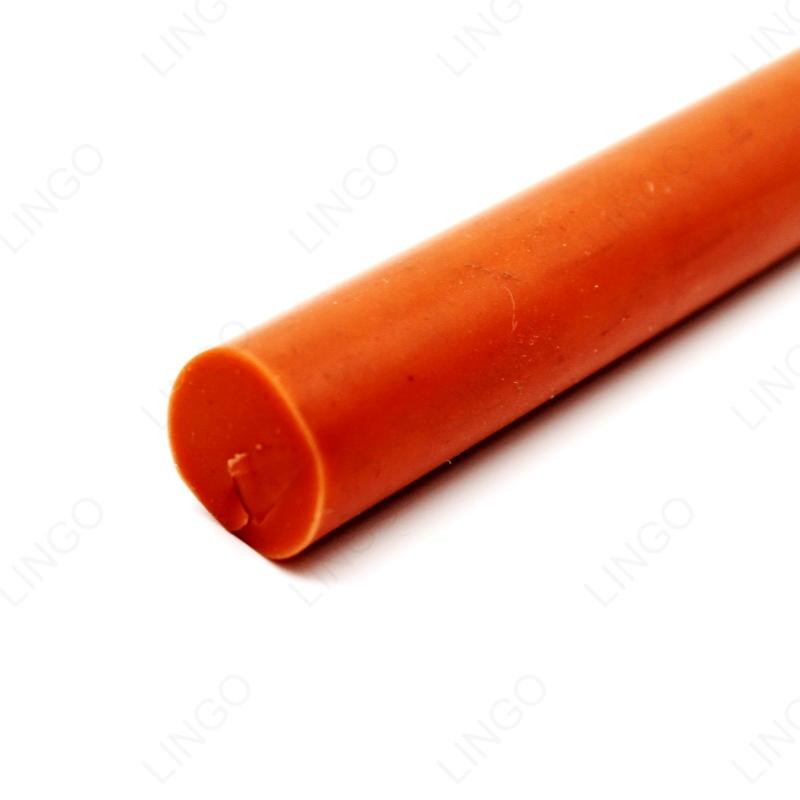
Silicone rubber extrusion cord: hardness and compound determine how the profile conforms under compression.
- Softer compounds (lower Shore A) conform well to uneven or lightly damaged surfaces and seal at low compression, which suits thin-walled housings, plastic frames and hand-tightened covers. The trade-offs are lower resistance to compression set under continuous load and a greater tendency to extrude into gaps.
- Harder compounds (higher Shore A) hold their shape, resist gap extrusion and recover better after long compression, but they require more closing force and tolerate surface irregularity less.
- Sponge profiles sit outside the usual hardness logic. They are chosen where the joint has very little compression travel and the priority is sealing at minimal load rather than carrying load.
For a reference point on house capability, Lingo's molded rubber sealing rings (LG-RS) are normally specified from 50 to 95 Shore A. LG-RX extrusion seals are quoted to Shore A as required, which means the value is set against the application rather than taken from a catalogue default. Two numbers in the specification do most of the work: the designed compression percentage and the joint gap. Where the gap is wide and the internal pressure is high, hardness moves up. Where the surface is rough, the compression travel is small, or the assembly is closed by hand, hardness moves down.
Step-by-Step: Specifying a Rubber Extrusion Seal in Seven Steps
- Define the operating environment. Record the temperature window, whether the seal sees sunlight and ozone, the media it contacts (water, air, oil, coolant, cleaning agents), the pressure it holds and whether the joint moves. This single page produces the shortlist; skipping it is the most common cause of later rework.
- Choose the polymer family. EPDM where outdoor weathering dominates and oil contact is absent; NBR where oil and fuel dominate; silicone where the temperature band is wide or food and medical contact requirements apply; FKM where aggressive media and heat combine. Confirm which classification the buyer's quality team expects — ASTM D1418 and ISO 1629 for the material family, ASTM D2000 where automotive temperature and oil resistance must be demonstrated.
- Set the Shore A hardness. Use the compression percentage and the joint gap to decide whether the profile must conform or resist, verify that the compression set target is acceptable for the load, and write the value on the drawing rather than in an email thread.
- Select the profile construction. Solid, sponge, co-extrusion or adhesive-backed. Each option changes the installation method and the closing force as much as it changes sealing performance.
- Fix the cross-section and the tolerances that matter. Extrusion seals are produced to industry-standard tolerances, so the drawing should prioritise sealing-critical dimensions — lip height, overall height, base width — instead of treating every feature as equally critical. A dimension inspection during production is where a profile either holds the drawing or starts to drift.
- Lock the customization parameters. Length is produced as required, and colour is matched to a Pantone or RAL reference. For visible weatherstripping or colour-coded production lines, that reference belongs on the purchase order.
- Validate with samples before mass production. Sampling is where hardness, compound and cross-section geometry are confirmed together. Lingo's routine for these programs is full inspection of samples followed by random inspection of bulk goods, backed by a batch traceability system. Treat the sample stage as the point at which the specification is closed, not as a formality before ordering.
Use Cases: Where These Specifications Get Tested
Silicone sponge cords in EV and enclosure sealing. A project delivered for an automotive OEM client in the United Arab Emirates involved 4,000 meters of silicone sponge cords over a three-year program. The recorded performance profile is thermal stability from -60°C to 250°C without hardening or cracking, UV-proof and ozone-resistant behaviour for outdoor service, closed-cell construction that keeps out water, dust and noise, and a non-toxic formulation with FDA-compliant options for food and medical use. The application list from that program covers EV battery sealing, industrial cabinet gaskets, automotive door seals, appliance door insulation, building window weatherstripping and medical device sealing. Documented highlights include FDA silicone sponge rubber, high-precision tolerance, high temperature resistance and a smooth surface finish.
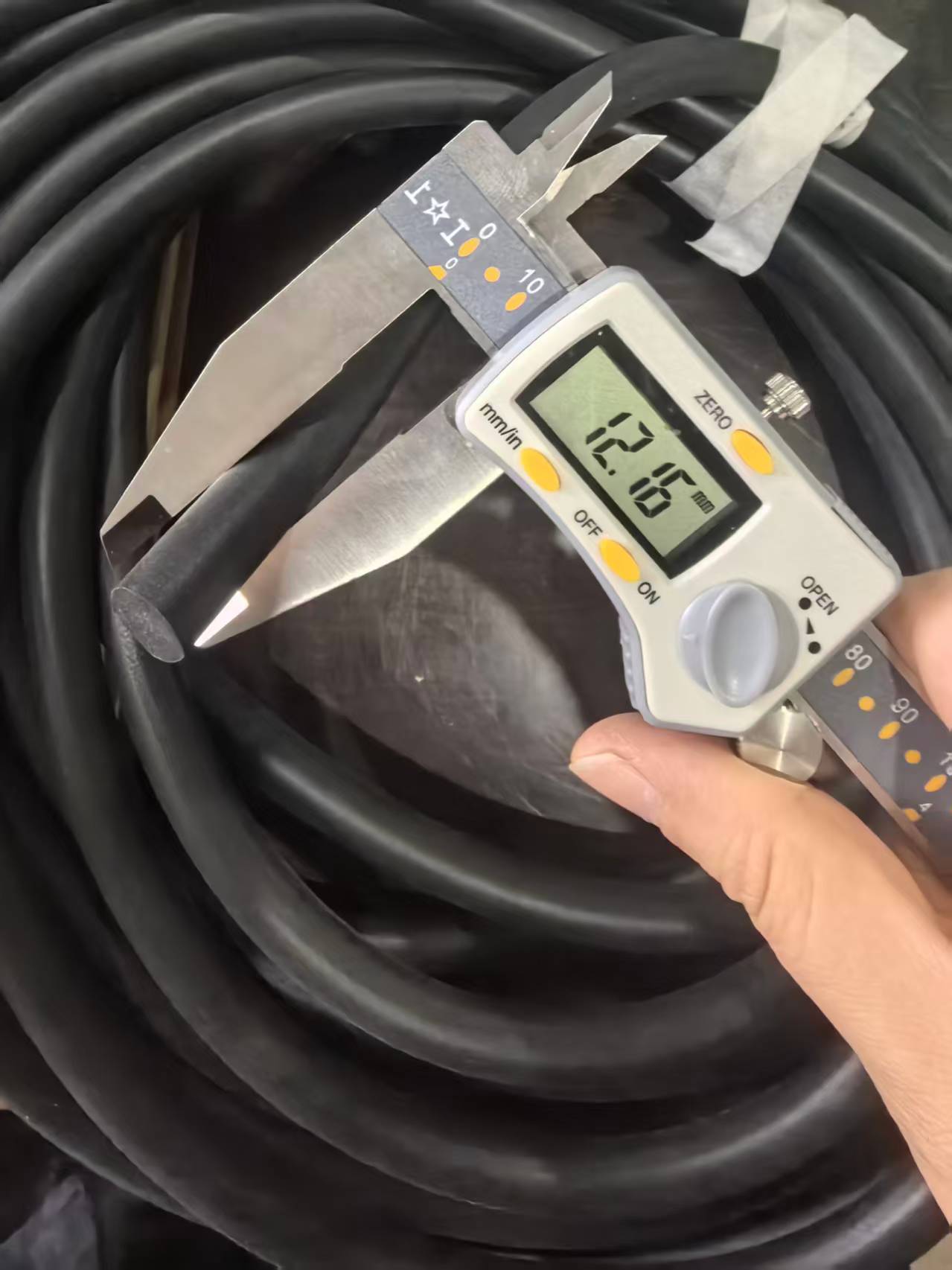
Dimension inspection: cross-section tolerances are checked against the drawing during production.
Water sealing with an FDA-grade white compound. A separate sealing program serving water treatment equipment manufacturers and food industry clients ran across the US, GB, Canada, Australia, France and Germany, with 1,000 units in service over three years and a reported result of stable operation, dimensions within tolerance and zero claims. The compound was FDA-certified white rubber, and the case notes record high precision as a requirement, together with a solution to the common problem of metal parts shifting during rubber production when no positioning point exists.
Flame-retardant requirements in battery and electronics enclosures. Where a seal sits inside a battery pack or an electronics cabinet, flammability can become a specification line in its own right. A CR Neoprene compound used across Lingo's sealing range passed the UL 94 V-0 vertical burning test at CTI, recorded under test report A2260538692101 and issued on 2026-07-03 for the EU, US and Middle East markets. That report is applicable to the rubber extrusion seal range as well as to molded rings and anti-vibration mounts.
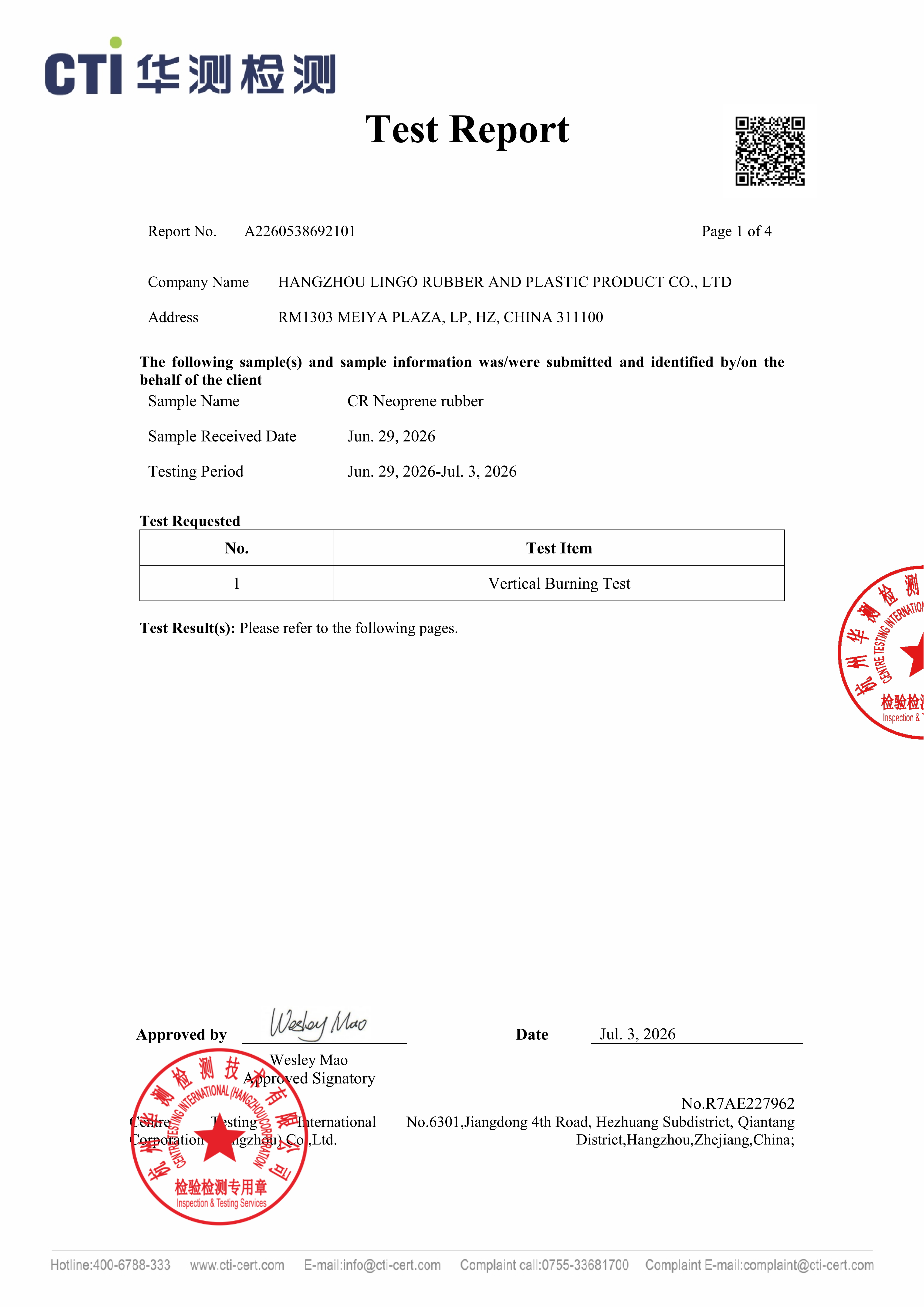
Flammability proof: CTI test report A2260538692101, UL 94 V-0 vertical burning test for a CR Neoprene compound.
Verified Specifications and Capability Data
The values below come from Lingo's product and capability documentation for the extrusion and sealing ranges. They are the numbers worth checking first, because they determine whether a specification can be quoted exactly as drawn.
| Parameter | Documented value |
|---|---|
| Product platform | Rubber extrusion seals — LG-RX |
| Materials | EPDM, NBR, silicone, FKM |
| Profile types | Silicone rubber extrusion seals, extrusion seal with adhesive, co-extrusion seal, FKM extrusion seal, solid extrusion seal, sponge extrusion seal |
| Hardness | Shore A as required (LG-RX); molded rubber sealing rings (LG-RS) normally 50–95A |
| Tolerance | Industry standards |
| Length | As required |
| Colour | Custom as per Pantone or RAL |
| Documented temperature references | LG-RS sealing ring platform: -40°C to 250°C; silicone sponge cords: -60°C to 250°C without hardening or cracking |
| Documented media performance | Ozone resistant, water resistant, oil resistant; silicone sponge cords recorded as UV-proof and ozone-resistant |
| Certification and documentation set | FDA, UL, RoHS and REACH for the sealing ring platform; PPAP documentation for automotive programs; CTI test report A2260538692101 (UL 94 V-0, CR Neoprene, issued 2026-07-03) |
| Production mode | OEM / ODM, including customization of rubber extrusion trims |
| Monthly capacity | 1,000,000 kgs |
| Lead time | 2 to 6 weeks |
| MOQ | Varies by part; small quantity orders accepted |
| Quality control | Full inspection of samples, random inspection of bulk goods |
| Export markets | EU, Middle East, USA |
| After-sales | Remote technical support, mold maintenance and ownership protection, batch traceability system, free exchange and acceptance of concessions |
Table 2: documented specification and supply data for the LG-RX rubber extrusion seal range.
FAQ: Hardness, Materials and OEM Supply for Rubber Extrusion Seals
Which standards and certificates apply to rubber extrusion seals?
Material family classification follows ASTM D1418 and ISO 1629, the standards that formally classify EPDM and define its resistance to ozone and UV. Where automotive temperature and oil resistance must be demonstrated, ASTM D2000 is the common reference for rubber seals and gaskets. On the manufacturer side, Lingo holds FDA, UL, RoHS and REACH documentation for its sealing ring platform, provides PPAP documentation for automotive programs, and holds CTI test report A2260538692101 for a CR Neoprene compound that passed the UL 94 V-0 vertical burning test, issued on 2026-07-03 and covering the EU, US and Middle East markets.
What Shore A hardness should I specify for an extrusion seal, and what range can be produced?
LG-RX extrusion seals are produced to Shore A as required, so the correct figure is the one that matches the application rather than a catalogue default. For reference on house capability, Lingo's molded rubber sealing rings (LG-RS) are normally specified from 50 to 95 Shore A. The practical rule is that softer compounds suit rough surfaces, low closing force and small compression travel, while harder compounds suit wide joint gaps, higher internal pressure and long-term compression load.
What should buyers check in an OEM rubber parts manufacturer for extrusion seals?
An OEM rubber parts manufacturer should do more than push a profile through a die: it should confirm polymer and hardness against the application, hold the cross-section to a defined drawing, and trace the batch. Lingo runs OEM and ODM production including customization of rubber extrusion trims, with a monthly capacity of 1,000,000 kgs and a typical lead time of 2 to 6 weeks. Quality control combines full inspection of samples with random inspection of bulk goods, and after-sales support covers remote technical support, mold maintenance and ownership protection, batch traceability, and free exchange with acceptance of concessions.
What is the minimum order quantity, and can length and colour be customized?
MOQ depends on the part, and small quantity orders are accepted. Length and colour are both customizable: extrusion seal length is produced as required, and colour is matched to a Pantone or RAL reference, so both parameters can be written directly onto the purchase order. Because extrusion is a continuous process, profile repeatability and quantity are best confirmed together at the quotation stage.
How are samples validated, and how long does production take?
Sampling is where hardness, polymer and cross-section geometry are confirmed together, and Lingo's routine for these programs is full inspection of samples followed by random inspection of bulk goods. Typical lead time is 2 to 6 weeks once the specification is closed. To start, send the profile drawing together with the media, temperature window, required hardness and polymer to sales@lingorp.com, or request a quote by phone and WhatsApp on +86 18358136245, and a sample can be scheduled for validation.
Conclusion: A Specification Sequence You Can Reuse
Extrusion seal performance is decided long before the profile is extruded. Environment first, then polymer, then Shore A hardness, then construction and cross-section, then the customization parameters, and finally sample validation. A seal specified in that order has an explainable reason for every line on its drawing, which is also what makes a claim defensible if a joint later leaks.
The LG-RX range covers EPDM, NBR, silicone and FKM, with hardness to Shore A as required, length as required, colour to Pantone or RAL, and profile options including solid, sponge, co-extrusion, adhesive-backed and FKM extrusion seals. Lingo Rubber Plastic supports the specification stage directly: OEM and ODM production, a monthly capacity of 1,000,000 kgs, a 2 to 6 week lead time, and quality control based on full sample inspection plus random bulk inspection with batch traceability.
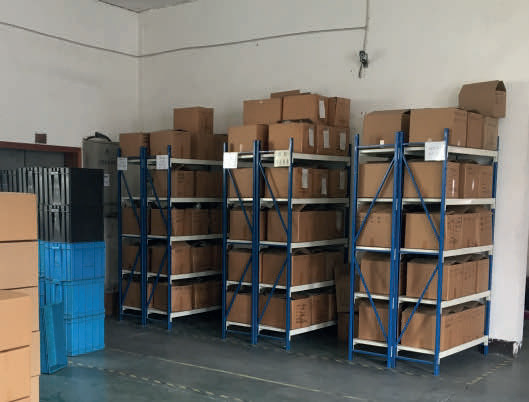
Warehouse and dispatch: extrusion seal runs are produced and released against the approved sample specification.
Next step: request a sample or a quotation for your extrusion seal profile at www.lingorp.com, email sales@lingorp.com, or message +86 18358136245 on WhatsApp. The full capability, certification and product range is summarised in the LINGO RUBBER & PLASTIC COMPANY PROFILE (PDF, open access).
Have Questions or Need More Details?
Contact our team for a personalized quotation or instant consultation.
Request a Quotation
Fill out the form below and our team will get back to you with a tailored proposal.
WhatsApp Direct Chat
Prefer to chat in real-time? Message us on WhatsApp for instant assistance & quick answers.
- Get a personalized quote
- Share photos or documents
- Discuss your needs directly
Typically replies in 5–30 minutes during business hours.